
Food and Literacy; Big Food is taking advantage of 45 million of America’s most vulnerable people
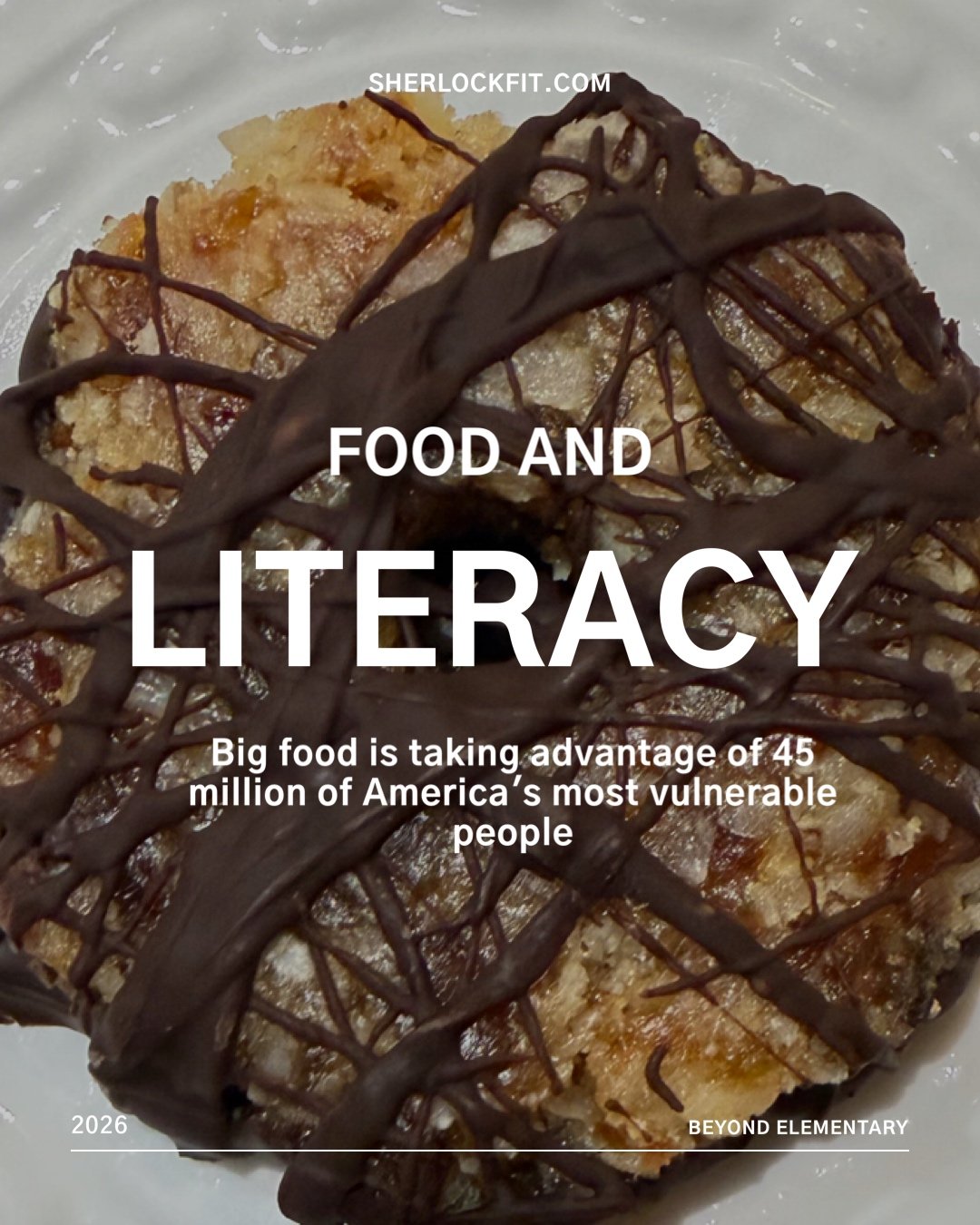
Food and Literacy
"You're like a dog with a bone once you get something in your head" — my mother
I've been thinking a lot about Girl Scout cookies. About our relationship to fundraising as communities. About what we owe each other when it comes to food. The Girl Scouts began baking cookies to sell in 1917, and by the 1920s they switched to commercial bakeries. I am in favor of anything sold to the public being made in a commercial kitchen. I have seen hoarders. I prefer to be cautious.
My issue with the Girl Scouts of America has nothing to do with the girls. It has everything to do with the ingredients they use to save money, the corn syrup hiding behind cleaner-sounding names, and the truly creative way the packaging is written to make you feel good about a product that should make you feel concerned. I find it abhorrent to advertise that the cookies contain no high fructose corn syrup when they still use corn syrup, and that they contain no palm oil when the recipe calls for a blend that includes palm kernel and palm oil. I am one person, Megan A. Sherlock, fitness professional and health enthusiast, and I know saving the world isn't up to just me. I also know I want to try to help.
This Is Not a You Problem. It Is a Design Problem. It is a Problem DESIGNED by companies who care about money over people.
Food companies are capitalizing on a literacy crisis that impacts us all. They count on people like me to get frustrated and throw up our hands, knowing we can eat around these problematic foods. They rely on the fact that 21% of American adults, roughly 45 million people, are not able to fully understand the packaging on the products they buy. If you have ever stood in a grocery store aisle feeling overwhelmed or quietly outsmarted by a label, that feeling was engineered. Food companies employ teams of lawyers, marketers, and food scientists whose sole job is to make their product sound cleaner and more wholesome than it is. When Little Brownie Bakers plasters "No High-Fructose Corn Syrup" on their packaging while quietly listing corn syrup and a palm oil blend in the ingredients, that is not an accident. That is strategy.
The 45 million Americans who struggle with reading are not failing the system. The system was built without them in mind. For those of us who can read the label? The companies are counting on us being too busy, too tired, or too trusting to notice.
Here is your cheat code, here is the most important part of this post and the part I hope you take with you today: the front of the package is advertising. The back of the package is the truth. Ingredients are listed by weight, heaviest first. If a "wholesome" cookie's second ingredient is a mystery oil blend, now you know. If it’s enriched flour that’s also bad because it’s the crux of the class action lawsuit Girl Scouts of America are seeing. Adding the vitamins and minerals in later leads to other toxins(carcinogens) and the bleaching process robs the flour of fiber. Note to self I need to write a blog post about Fiber!
I am not a doctor. I am not a lobbyist. I am a fitness professional who reads labels in grocery store aisles and gets genuinely angry on your behalf. Everything I share, I share because I believe an informed community is a protected community. The companies banking on your confusion are spending millions to stay one step ahead. My TikToks, my recipes, this blog they cost you nothing. That is intentional. Knowledge hoarded helps no one. Knowledge shared is a revolution.
Many moons ago a teacher came across my page on TikTok, an enormous blessing of the algorithm misunderstanding that I teach fitness. It opened my eyes to this issue. My passion for fitness emerged as a youth athlete and only grew alongside my passion for sports as I read books on nutrition, received my monthly Runner's World, spent endless hours(and all my babysitting or lifeguarding money in the New Age or Health section) in Barnes and Noble, and eventually made my Capstone project in college on how food deserts are affecting our future. I think about how much it limits the enjoyment of our world when you cannot learn more when you want, however you want. Reading goes hand in hand with critical thinking, and we are living in a moment that demands both.
Little Brownie Bakers states on their website that all of their cookies have no high-fructose corn syrup, no partially hydrogenated oils, zero grams of trans fat per serving, and RSPO certified palm oil.
The second ingredient in their Samoas is vegetable oil, specifically a blend of palm kernel, palm, and soybean oil. Once something is blended this way, no one can guarantee anything. The third ingredient is enriched flour. Enriched flour exists because bleaching already glyphosate-exposed wheat strips it of nutrients, so some vitamins are added back in. Refined flour has been linked to weight gain, metabolic problems, cardiovascular disease, and some cancers. The next ingredient is corn syrup.
A 2024 report from GMOScience found that glyphosate and heavy metals, while not listed as ingredients on Girl Scout Cookie packaging, may be present through unsafe farming practices or during processing. Their testing found that 100% of samples were positive for glyphosate, 100% were positive for toxic metals, 88% were positive for all five toxic metals tested, 76% showed levels of cadmium exceeding EPA limits in water, and 96% were positive for lead. At six to seven dollars a box I would expect a more wholesome ingredient list and I would definitely not expect duplicitous business practices. Little Brownie Bakers does not deserve your money. Give your local troop the money directly and skip the middleman entirely.
When I developed my no-bake samoas recipe, based on a recipe a friend gave me. I was not just trying to make something delicious, I wanted to show other people how to make something delicious and beloved. I never had to opt out of this system because my Italian-American mother made homemade lunchables, we never trusted the system in our house. Three ingredients you recognize. No bleached flour. No corn syrup. No glyphosate-adjacent anything. Made in your kitchen, with your hands, for people you love, this is my family’s way. This is me calling anyone listening in to be part of my family to feel loved, and learn. This is not a small thing, nothing done with love is small.
History is full of ordinary people who pushed back against systems designed to exploit them, not always with protests or proclamations, but with quiet, deliberate, personal choices that added up to something enormous.
WWII Victory Gardens: When the government asked Americans to grow their own food to support the war effort, 20 million families dug up their backyards and balconies. At their peak, Victory Gardens were producing 40% of the nation's vegetables. Ordinary people. Ordinary soil. Extraordinary collective impact.
The Red Lip in WWII: When nylon stockings disappeared and cosmetics were rationed, women wore red lipstick anyway. It became an act of defiance, a refusal to be diminished by hardship. Small, personal, and deeply powerful.
The Boston Tea Party: Colonists did not just protest taxation, they refused to participate in a system they found unjust. They literally dumped the product in the harbor. Consumer boycotts have always been one of the most effective tools ordinary people possess.
The French Revolution: Before the internet, before social media, before any mechanism for mass communication as we understand it today, the French people organized. What began as fury over bread prices, the inability of ordinary people to afford basic food while the wealthy feasted, became one of history's most dramatic reorderings of power. Dr. Joseph-Ignace Guillotin, a physician and humanitarian, advocated for a more humane and equal method of justice, rooted in the belief that no person's life was worth more than another's under the law. The spirit of that revolution, the part worth carrying forward, is this: when enough ordinary people decide they have had enough, systems change. You do not need a guillotine. You need a grocery list and a food processor. If I can recommend the book Napoleon: A Life by Andrew Roberts I would also recommend The Great Courses “The French Revolution”
Making your own food, even once a week, even one recipe, is an act of reclamation. You are saying: I know what is in this. I chose this. This came from my hands. Every time you share a recipe, read a label out loud to a friend, or choose to give a Girl Scout troop money directly instead of funding a corporation built on confusion and corn syrup, you are participating in something bigger than a snack.
You are informed. You are awake. And you are not alone.
No-Bake Samoas Cookies (The Real Ones)
I made a no-bake recipe that is healthier, there is fiber and you know where everything came from, plus you are going to make it with love, right? You will need a cookie sheet, waxed paper, one chopstick, a double boiler, and your freezer.
Ingredients:
3 cups of unsweetened coconut
2 cups chopped medjool dates
1 tsp of sea salt
1 bag of dark chocolate
Instructions:
Blend all ingredients in a food processor until the mixture becomes dough-like. Taking rounded teaspoons, form balls and place them on waxed paper on a cookie sheet. Using another piece of waxed paper, flatten all the balls so they are the same size. Take the chopstick and make a hole in the center of each cookie — this makes dipping them in chocolate much easier. Freeze for at least 2 hours.
Melt the dark chocolate in a double boiler and dip each cookie, covering the bottom. Once the bottom of each cookie is covered, drizzle the remaining chocolate on top. Go nuts, divas. Pop back in the freezer and enjoy.
Nutrition Per Cookie (makes 24):
Calories: 165 | Total Fat: 10g | Saturated Fat: 8g | Carbohydrates: 20g | Dietary Fiber: 3g | Natural Sugar: 9g | Protein: 1.6g | Sodium: 20mg
All sugars are naturally occurring from whole medjool dates and dark chocolate. No refined sugar, flour, butter, or artificial ingredients. Numbers are estimates and will vary based on specific brands used.
Support the girls. Skip the cookie industrial complex.