
Arnica Montana
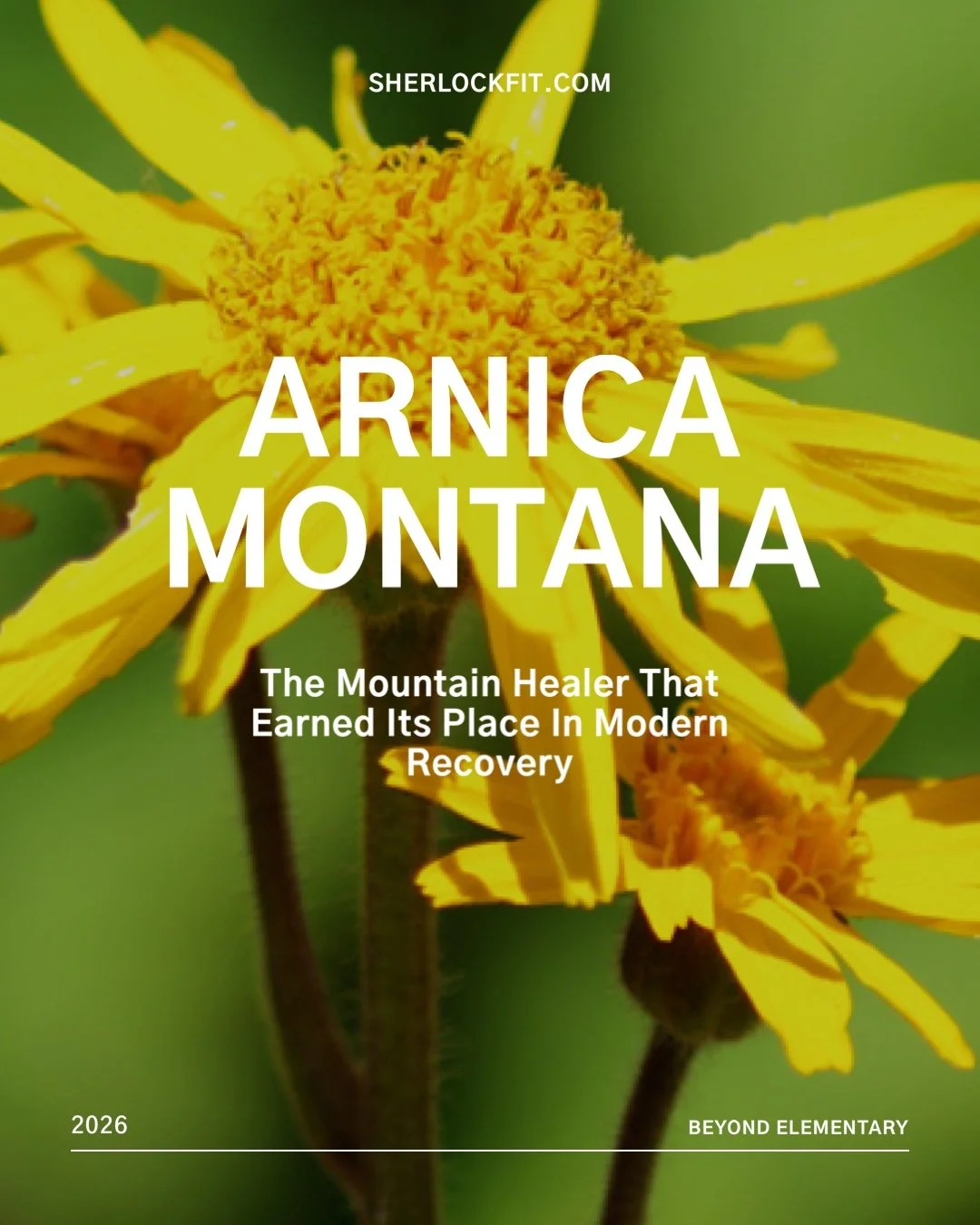
Arnica Montana: The Mountain Healer That Earned Its Place in Modern Recovery
Long before recovery became an industry — before foam rollers, percussion guns, and cryotherapy chambers — people who lived and worked in the mountains of Europe already had a remedy for the pain that followed hard physical effort. They reached for a bright yellow flower that grew wild in the thin, cool air above the treeline. They called it Arnica montana, and they trusted it the way we trust aspirin: not because someone marketed it to them, but because it worked, repeatedly, across generations.
That flower is still with us. And while the conversation around it has shifted from folk wisdom to clinical investigation, Arnica montana continues to occupy a rare and interesting space in the world of natural medicine — one where centuries of traditional use meet a growing body of modern interest.
A Flower Built for Harsh Ground
Arnica montana is a perennial herb belonging to the Asteraceae family, the same broad botanical family that includes sunflowers and daisies. It grows natively across the mountainous regions of Europe and parts of Siberia, favoring altitudes between 500 and 2,500 meters. You'll find it in alpine meadows, nutrient-poor grasslands, and open woodlands — environments defined by acidic, siliceous soils that most cultivated plants would reject outright.
The plant itself is modest in stature, typically reaching between 20 and 60 centimeters in height. Its basal rosette of oval, slightly hairy leaves sits close to the ground, and from the center rises a single, sometimes branching stem topped with vivid orange-yellow flower heads. Each flower is roughly five to eight centimeters in diameter, with ray florets that fan outward in a slightly irregular pattern — not the tidy symmetry of a cultivated daisy, but something wilder, less manicured. The entire plant is aromatic when crushed, releasing a scent that is sharp and herbaceous, faintly reminiscent of chamomile but more resinous.
Arnica's preference for undisturbed, high-altitude ecosystems has made it increasingly difficult to find in the wild. Overharvesting and habitat loss have pushed it onto protected species lists in several European countries, which has in turn driven the development of cultivated sources and the use of related species like Arnica chamissonis for commercial preparations.
Roots in Mountain Medicine
The documented use of Arnica montana stretches back to at least the sixteenth century, though its practical application almost certainly predates written records. Swiss and Austrian mountain communities used it as a poultice for bruises, sprains, and the deep muscle aches that came from days of physical labor at altitude. In the German-speaking Alps, it earned the folk name Bergwohlverleih — loosely translated as "mountain well-being" — a name that speaks to how embedded it was in everyday life.
By the 1500s, European herbalists had begun cataloging Arnica's uses more formally. It appeared in herbals as a treatment for falls, contusions, and what early physicians described as "trauma to the soft tissues." The plant was prepared as a tea, a compress, and eventually a tincture, with each preparation suited to different types of complaints.
The most significant shift in Arnica's history came in the late eighteenth century, when Samuel Hahnemann — the German physician who founded homeopathy — identified it as one of the cornerstone remedies in his new system of medicine. Hahnemann's approach involved extreme dilution and succussion (vigorous shaking), and Arnica became one of the first substances he "proved," meaning he systematically tested its effects on healthy individuals to catalog its symptom profile. In homeopathic philosophy, Arnica's affinity for bruising, soreness, and shock made it the go-to remedy for physical trauma of nearly any kind.
That designation has endured. Walk into any homeopathic pharmacy today, anywhere in the world, and Arnica will be among the most prominently displayed remedies. Its reputation has not faded with time — if anything, it has broadened.
How Arnica Functions in Homeopathic Practice
To understand Arnica's role in homeopathy, it helps to briefly understand the framework itself. Homeopathy operates on the principle of "like cures like" — the idea that a substance capable of producing certain symptoms in a healthy person can, in highly diluted form, stimulate the body's own healing response to those same symptoms.
In homeopathic terms, Arnica montana has a very specific symptom picture. It is associated with:
Physical trauma: bruises, muscle soreness, blunt-force injuries, and post-surgical tissue damage
Soreness and achiness: the feeling of having been "beaten up," where the whole body feels tender
Shock and emotional withdrawal: a mental state following injury where the person insists they are fine and resists being touched or examined
Circulatory disturbance at the tissue level: pooling of blood beneath the skin, swelling, and inflammation following impact
Practitioners typically select Arnica when the presenting complaint matches this profile. The potency — expressed in designations like 6C, 30C, or 200C — is chosen based on the intensity and nature of the symptoms, with lower potencies generally used for mild, localized complaints and higher potencies reserved for more acute or systemic presentations.
The mechanism by which ultra-dilute homeopathic preparations produce clinical effects remains a subject of active scientific debate. Skeptics point to the extreme dilutions as evidence of implausibility, while proponents cite clinical outcomes and emerging research into nanoparticle retention and water structure. What is less debatable is the sheer volume of people — patients, athletes, surgeons, midwives — who continue to use and recommend it based on their direct experience.
Forms and Preparations: Matching the Remedy to the Need
One of Arnica's practical strengths is its versatility in form. Different preparations serve different purposes, and understanding the distinctions helps in choosing the right one.
Gel Arnica gel is among the most widely available topical preparations. It absorbs quickly, leaves minimal residue, and is well-suited for acute application over bruises, sprains, and areas of localized swelling. The gel format works particularly well on skin that is intact but inflamed — think a rolled ankle, a banged shin, or the kind of deep-tissue soreness that follows an intense training session. Many athletes keep a tube in their gym bag for exactly this reason.
Cream Arnica cream tends to be richer and more emollient than gel, making it a better choice for broader application or for skin that benefits from additional moisture. It is often used in post-surgical recovery, applied around (never directly on) incision sites to help manage bruising and swelling. Some massage therapists incorporate Arnica cream into their practice, using it during deep-tissue work to support the body's response to manual therapy.
Tablets and Pellets Homeopathic Arnica tablets and pellets are the internal-use form most people encounter. These small, lactose- or sucrose-based pellets are dissolved under the tongue, allowing the remedy to be absorbed through the mucous membranes. They are commonly taken before and after surgery, dental procedures, intense physical exertion, or any event expected to produce significant tissue stress. Dosage and potency vary, but a common protocol for acute use involves taking a dose of Arnica 30C every few hours in the immediate aftermath of an injury or procedure, then tapering as symptoms improve.
Tinctures Arnica tincture — a liquid extract preserved in alcohol — represents a more concentrated herbal preparation and is distinct from the ultra-dilute homeopathic form. Tinctures are primarily used topically, diluted in water, as compresses or added to foot soaks. They are not typically taken internally in their undiluted herbal form due to the presence of helenalin, a sesquiterpene lactone that can irritate the stomach and, in larger amounts, cause toxicity. When used externally, however, tinctures offer a potent and direct application method.
Oils and Salves Arnica-infused oils and salves are made by steeping the dried flowers in a carrier oil — often olive, sunflower, or jojoba — over a period of weeks. The resulting preparation is gentle enough for regular use and integrates well into self-massage, warm-down routines, and evening recovery practices. A salve, thickened with beeswax, offers a slower-absorbing alternative that can be applied before sleep, allowing the preparation to work over several hours.
Where Arnica Meets Daily Life and Athletic Recovery
The practical applications of Arnica montana map neatly onto the demands of an active life. Consider the common scenarios:
A distance runner finishes a long weekend effort and feels the accumulated impact in her quads and calves. She applies Arnica gel to the most tender areas within thirty minutes of finishing, then takes a dose of Arnica 30C pellets before bed. The combination of topical and internal support addresses both the localized tissue response and the systemic sense of being "wrung out."
A weekend climber misjudges a hold and takes a short fall, landing hard on one hip. No fracture, but the bruise is already deepening by the time he gets home. He applies Arnica cream to the area twice daily for the next three days, watching the bruise cycle through its colors faster than he expected.
A person recovering from knee surgery follows their surgeon's rehabilitation protocol carefully. Alongside prescribed medications, they add homeopathic Arnica tablets in the days surrounding the procedure — a practice increasingly common among integrative-minded orthopedic patients and one that several published trials have examined with encouraging, if not yet definitive, results.
These are not dramatic claims. They are the quiet, practical ways people have used this remedy for a very long time.
At Sherlockfit, recovery is treated not as an afterthought but as a discipline in its own right — as intentional and structured as the movement that precedes it. The platform's emphasis on emotional awareness in the body aligns naturally with remedies like Arnica, which ask the user to pay attention: Where does it hurt? What kind of pain is it? When did it start? This kind of attentive self-inquiry is the foundation of any meaningful recovery practice. Reaching for Arnica after a hard session becomes less about grabbing a product off a shelf and more about listening to the body's signals and responding with precision. That mindset — treating the body as something worth attending to, not just pushing through — is central to what high-performance recovery actually looks like when the marketing is stripped away.
Incorporating Arnica into a Wellness Routine
For those interested in working Arnica into their regular practice, a few practical principles apply:
Start with topical use. Arnica gel or cream after training sessions, long hikes, or physically demanding days is the simplest and most accessible entry point. Apply it to areas of soreness or anticipated bruising. Use it consistently for a week and observe how your body responds.
Use homeopathic pellets for acute events. If you're heading into surgery, a demanding race, or a period of especially intense training, consider adding Arnica 30C pellets to your preparation and recovery toolkit. Begin a dose the evening before and continue for two to three days after.
Pair it with intentional recovery practices. Arnica works best not in isolation but as one element in a broader recovery approach. Combine it with adequate sleep, mindful movement on rest days, hydration, and — where appropriate — professional bodywork. The goal is a system, not a single fix.
Keep a preparation accessible. Having Arnica gel in your training bag and pellets in your medicine cabinet means you can respond quickly when the need arises. Acute application — within the first hour of an injury — is generally more effective than delayed use.
Safety, Contraindications, and Responsible Use
Arnica montana is broadly well-tolerated when used appropriately, but "natural" does not automatically mean "without risk." A few clear guidelines are worth respecting:
Never apply topical Arnica to broken skin. This includes open wounds, deep abrasions, and surgical incisions. The active compounds, particularly helenalin, can cause significant irritation and delay healing when they contact damaged tissue.
Do not ingest herbal-strength Arnica preparations. Undiluted Arnica tincture or raw plant material taken internally can cause gastrointestinal distress, elevated heart rate, and, in extreme cases, organ damage. Internal use should be limited to properly prepared homeopathic potencies (typically 6C and above), which have undergone serial dilution.
Watch for allergic reactions. Individuals with known sensitivity to plants in the Asteraceae family — ragweed, chrysanthemums, marigolds — may react to Arnica. Test a small area of skin before broad application, especially with a new preparation.
Pregnancy and nursing. As with most herbal and homeopathic preparations, pregnant and breastfeeding individuals should consult a qualified practitioner before use. The data on safety during pregnancy is limited, and caution is warranted.
Medication interactions. Those taking blood-thinning medications should use Arnica topically with awareness, as some evidence suggests it may influence platelet activity at the tissue level. Consult a healthcare provider if you are on anticoagulant therapy.
Children. Homeopathic Arnica pellets are widely used in pediatric settings — bumps, falls, and the general chaos of childhood — but dosing should follow the guidance of a trained homeopath, particularly for very young children.
A Remedy That Respects the Body's Intelligence
What makes Arnica montana enduring is not mystery or marketing. It is the fact that it addresses something fundamental about being in a body that moves, works, trains, and occasionally gets hurt. It does not override the body's processes. It supports them. It reduces the noise of inflammation so the deeper work of repair can proceed without unnecessary interference.
That philosophy — respecting the body's own intelligence while giving it carefully chosen support — is not unique to homeopathy. It runs through every serious approach to movement, recovery, and long-term physical resilience. It is the same principle that makes a thoughtful warm-down more valuable than a haphazard one, that makes sleep a performance tool rather than a concession to weakness, and that makes paying attention to pain a skill rather than a nuisance.
Arnica montana has been doing this work — quietly, reliably, without fanfare — for longer than most of us have been alive. For those willing to learn its uses and respect its boundaries, it remains one of the most accessible and practical tools in the natural recovery toolkit.
This article is intended for educational purposes and does not constitute medical advice. Consult a qualified healthcare professional before beginning any new supplement or remedy, particularly if you are managing a medical condition or taking prescription medications.
Megan Sherlock is a wellness professional passionate about somatic movement and holistic healing. She combines her expertise in fitness, yoga, and nutrition with the transformative power of energy work to help clients reconnect with their bodies and emotions. Megan holds certifications in NASM CPT, RYT 200, CGFI, CNC, BCS, CF1, ViPR, TriggerPoint SMR, Usui Reiki Master, and PN1. Experience her training in app